
We were three gates deep, sitting on 4.2x, and the cursor was hovering over the cashout button doing absolutely nothing. The chicken kept running. The next set of gates came up – 1.4x, 2.1x, 6.0x – and the timer started its five-second countdown, which is roughly four and a half seconds longer than we needed and somehow not long enough. We took the 6.0x. A train arrived. The chicken did not.


That round cost us 40p, and it taught us more than the first hundred combined. Chicken Subway is easy to describe and surprisingly hard to play well, and most of what has been written about it covers the first part while skipping the second. So we spent proper time with it – in demo, in real money, on desktop and on a phone on a delayed train. No breathless superlatives, no promises about outcomes. Just an honest account of what the game does, where it gets you, and who it suits.
Chicken Subway Beginner Guide UK: Before Your First Round
If you have heard the name but never opened the game, here is the shape of it. Chicken Subway is an instant crash-style title from 100HP Gaming, a studio founded in 2022 and based in Limassol. A chicken runs along three parallel subway tracks. At each step, three gates appear, each carrying a different multiplier. You pick a lane, the chicken runs through that gate, and your total multiplier climbs – or a train arrives and the round ends with your stake gone.
There is no auto-cashout. You press the button yourself, every time, which is either the game’s best feature or its most exhausting one depending on your temperament. Rounds are short, sessions are dense with decisions, and it all runs in a browser with no app to install.
| At a glance | Details |
|---|---|
| Studio | 100HP Gaming (founded 2022, Limassol) |
| Format | Instant crash game with lane selection |
| RTP | Quoted between 96% and 98%; check the in-game info screen |
| Stakes | £0.10 to £150 per round |
| Maximum win | £10,000 per round |
| Round length | Roughly 15 to 30 seconds |
| Lanes | Three, with three gate multipliers per step |
| Cashout | Manual only – no auto-cashout function |
| Fairness | Provably fair, SHA-256 seed verification |
| Platform | Browser, desktop and mobile; no download |
| Demo | Free, identical mechanics to real-money play |
Two of those numbers move depending on where you play. Operators set their own stake limits, and the RTP quoted publicly sits in a band rather than at a single point. Check the game’s own info screen before assuming anything, and treat any site quoting 99% with the scepticism it deserves.
Chicken Subway Game Mechanics: The Lane, Explained
Here is the part that matters, and it is the part most write-ups fudge. The bust point for a round is decided by the random number generator before the round begins. Not while you are choosing. Not as the multiplier climbs. Before. Your lane choice selects which pre-calculated multiplier threshold you are walking towards; it does not create that threshold, negotiate with it, or nudge it in your favour.
This distinction is worth sitting with, because the presentation works against it. The chicken has momentum. The trains have speed. The lanes look like they carry different risk profiles because the gate numbers differ. All of that is true at the level of the multiplier maths and none of it is true at the level of the RNG. You are picking from a menu printed before you sat down.
What we noticed is that this takes a few dozen rounds to internalise. The visual language of a runner game says reflexes, and the underlying model says nothing of the kind. Reaction speed does not save you. Judgement about when to stop is the only lever you actually hold.
On fairness, the game uses a provably fair system, and it is worth understanding in one paragraph. Before a round, the server generates a secret value – the server seed – and shows you a cryptographic hash of it, which is a fingerprint that cannot be reverse-engineered but also cannot be changed after the fact. Your client seed and a round counter called a nonce get mixed in. After the round, the server reveals the original seed, and you can run the whole combination through any independent SHA-256 calculator to confirm the result matches the fingerprint you were shown before you bet. We checked the verification process on a handful of rounds and the hashes matched. It is not a guarantee of winning anything; it is proof the number was not changed once your money was on the table. Those are different things, and only one of them is available.
A Round, Slowed Down
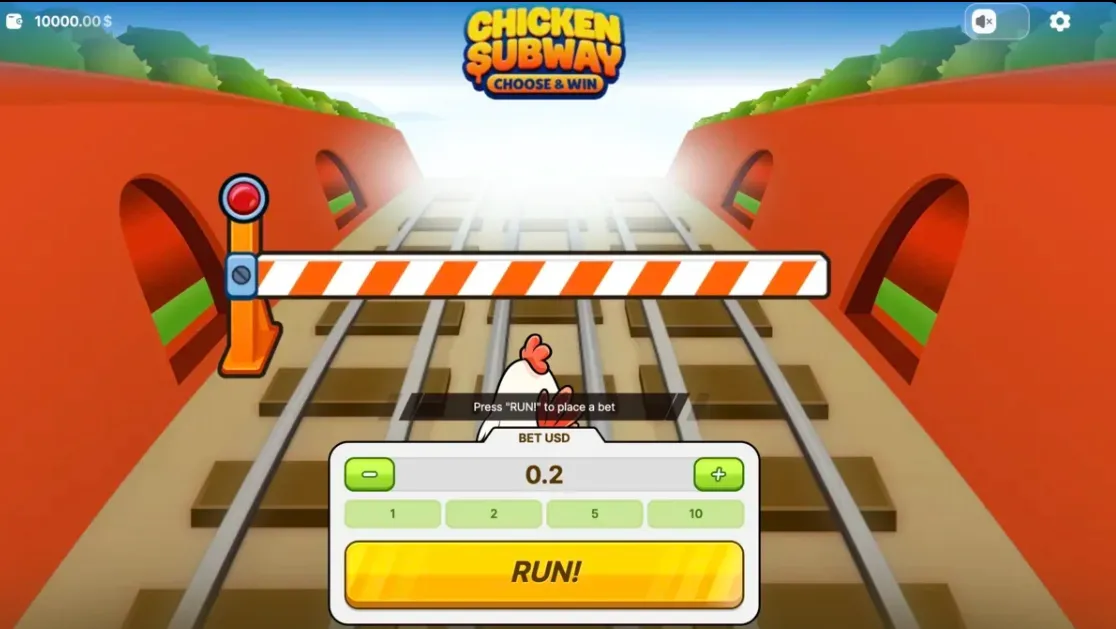
1. Set the stake
Watch us play one. The stake box says 20p, which is the sort of number that feels like it does not count. It counts. It is the only decision in the entire round that you make in a state of complete calm, and the temptation is to make it carelessly precisely because it feels trivial. Everything after this point is made under pressure.
2. Read the gates
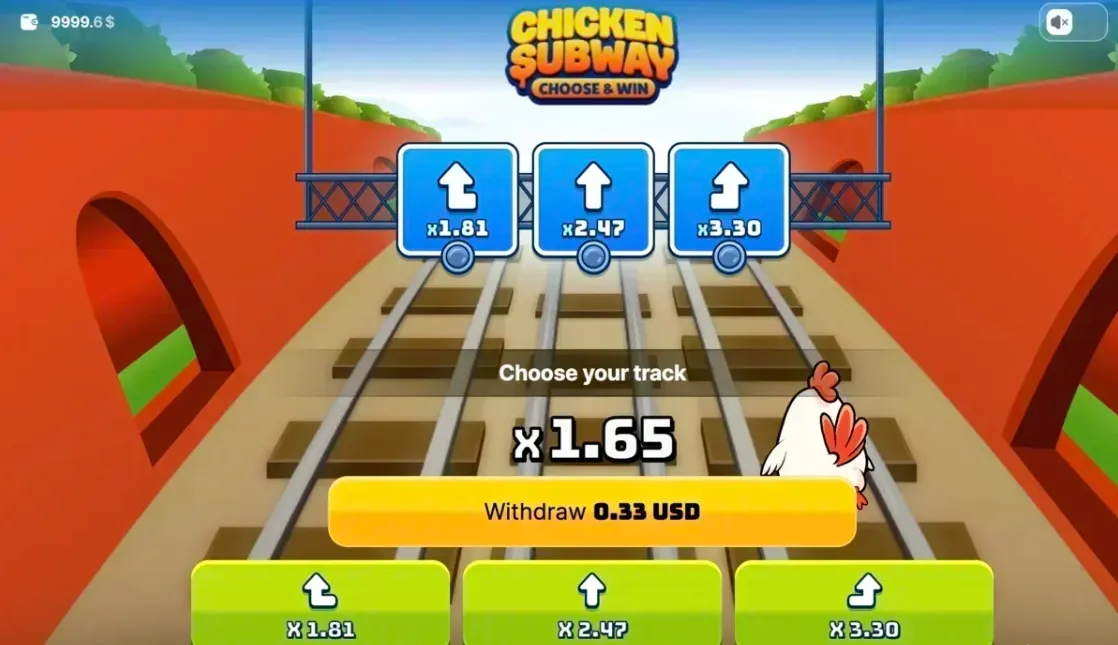
The chicken sets off down the middle track. Three gates appear: 1.5x, 2.4x, 5.0x. Our eye went to the 5.0x before our brain had finished reading the other two, and we suspect yours would too. That pull is the game’s engine, and it is no accident.
3. Make the choice
The five-second timer starts. Five seconds is a strange interval. It is long enough to know you are thinking and short enough that you cannot finish. We took the 2.4x, on the grounds that we had a plan, and the plan survived contact with exactly one set of gates.
4. Face the cashout moment
Now the multiplier reads 2.4x and the cashout button is right there. This is the moment the game is built around. At 2.4x, cashing out is obviously sensible and emotionally trivial to skip. At 5.8x, cashing out is still sensible and has become genuinely hard, because the number now feels like something you own rather than something you might keep. Nothing has changed mathematically. Everything has changed in your chest.
5. Accept the outcome
We did not press it. The next gate was a train. The round ended at 5.8x, and here is the observation we keep coming back to: busting at 1.3x feels like nothing, and busting at 8.7x feels like being robbed. The two are mechanically identical. Both are a lost 20p. Only one of them will make you place the next bet faster than you meant to.
Is Chicken Subway Fair? What 96%–98% RTP Means
Return to player is a long-run statistical average, and the emphasis belongs on long-run. A 96% RTP does not mean you will end a session with 96% of your stake. It means that across a very large number of rounds – millions, aggregated across every player – the game returns approximately £96 for every £100 wagered. Your twenty rounds this evening are not a sample from which anything useful can be drawn.
The house edge, then, is somewhere between 2% and 4%. For context, that is meaningfully better than most online slots, which typically run at 4% to 8%, and it lands in similar territory to blackjack played with correct basic strategy. On a pure cost-of-entertainment basis, this is a competitively priced game.
Variance is the other half of the story and the half people ignore. Over twenty rounds, the outcome is close to unpredictable and the RTP tells you nothing. Over twenty thousand rounds across the player base, the figure settles where the maths says it should. You are not playing the long run. You are playing the noisy bit at the start of it.
Our take is straightforward: this is a fair game with a below-average cost of entertainment per pound staked, backed by verification you can actually run yourself. That is a genuine compliment and it is also the whole of the compliment. A low house edge is not a strategy, and a verifiable seed is not a forecast.
Four Mistakes Most Players Make in the First Session
These are not generic warnings. They are the four things we have watched people do, repeatedly, in their first hour with this game – and, in the interest of honesty, at least three of them are things we did ourselves before we knew better.
Treating the lanes as different odds
Players develop lane loyalty within about ten rounds. The left one has been kind, the right one is cursed, that sort of thing. A lane’s history has no predictive power whatsoever, because the bust point was set before you arrived and the lane you pick simply selects which threshold you are walking towards. Choosing the same lane every single round is identical in expected value to randomising. The pattern you think you see is your brain doing what brains do with noise.
Jumping to Hard mode before understanding Easy
Hard mode compresses the multiplier window, which sounds like an efficiency gain and functions as a pressure multiplier. You get less room between the interesting numbers and the end of the round. Our recommendation is unfashionably boring: play Easy for the first twenty to thirty rounds, until your cashout rhythm is something you have rather than something you are improvising. Then move up, if you still want to.
Running auto-mode unsupervised
Auto-bet is where sessions quietly get away from people. It will happily execute forty to sixty rounds while your attention is on a message or a kettle. Nobody decides to play sixty rounds without watching; it simply happens, and the total is only visible afterwards. If you use it, set a hard round limit, set a stop-loss, and stay at the screen. An unsupervised auto-bet is not playing the game. It is standing next to it while it runs.
Interpreting near-misses as signal
Busting at 9.2x when you meant to cash at 8x is not a near-miss. It is a loss, and it is exactly as much of a loss as busting at 1.1x. The word ‘nearly’ is doing enormous emotional work there and describing nothing real. The next round is statistically identical to every other round, and it does not know what just happened to you. Near-miss architecture is the most effective psychological feature in this entire category of game, and recognising it is most of the defence against it.
What the Demo Is Actually Useful For
Everyone says try the demo. Almost nobody says why, and ‘practise without risk’ is not an answer, because there is no skill here to practise in the usual sense.
What we think it is genuinely for, in order of usefulness. First: finding your personal cashout threshold – the number at which you are comfortable stopping – without paying tuition fees to discover it. Second: watching your own reaction after a bust at a high multiplier, in conditions where the loss is fictional. That reaction is the thing that costs money later, and the demo is the only place you will ever meet it for free. Third: getting a feel for bust frequency across different multiplier ranges, so your expectations arrive from observation rather than optimism.
What the demo does not do is predict anything. The RNG resets independently for every round, in demo and in real money alike. A demo hot streak is not momentum you can carry across. It is just a set of numbers that already happened.
Chicken Subway vs Aviator and Other Things You Know
Rather than filing this game into a category, here is what changes if you arrive from something familiar.
If you’ve played Aviator
The headline difference is decision count. Aviator asks one question per round: when do you press? Chicken Subway asks two, repeatedly – which lane, and when do you press. In our experience that splits players cleanly. Some find the extra choice makes the round theirs rather than something they are watching. Others find it doubles the pressure without doubling the pleasure. Neither reaction is wrong, and you will know which you are within about fifteen rounds.
If you’ve played online slots
The pace will feel familiar. The control will not. A slot asks you for a stake and then requires nothing from you at all – the reels do their thing, and your involvement is complete before the outcome exists. Here you are in it, every round, making calls that feel consequential. We found that players who like slots for the switching-off tend to find this game tiring, and players who found slots passive tend to prefer it immediately.
If you’ve never played a crash game
Start in the demo, and do not skip it out of pride. Set a cashout target before the round starts – an actual number, said out loud if that helps – and then do not revise it mid-round. Revising it mid-round is the entire problem in miniature, and knowing that in advance will not stop you doing it, but it will help you notice.
Session Management and Chicken Subway Strategy Tips
This is the practical bit, and we are not going to moralise. The aim of everything below is a longer, better session, not a bigger win – nobody can offer you the second one.
- ✓Set the session budget before you open the browser, not after the first bust. A number decided under pressure is not a budget; it is a negotiation you are having with yourself, and you will lose it.
- ✓Stake 1% to 2% of that bankroll per round. On a £50 session, that is 50p to £1. It looks small and it is meant to – it is what makes the session last long enough to be worth having.
- ✓Pick your cashout target before the round begins. Not while the multiplier climbs. The number you choose at 1.0x and the number you would choose at 4.5x are different numbers, and only the first one was chosen by the rational version of you.
- ✓Plan by clock, not by target. Chicken Subway runs at roughly two to three rounds per minute, which means a session has a length in minutes whether you planned one or not. ‘Twenty minutes’ is a plan. ‘Until I’m up £30’ is not a plan, it is a hostage situation.
The single most useful habit we picked up is also the least exciting: after a session ends, win or lose, wait ten minutes before starting another. Not as punishment, but because the decision to keep going is worth making from a standing start rather than from momentum. Ten minutes is enough for the last round to stop being the loudest thing in your head.
This is an 18+ game. Everything above assumes money you can afford to lose entirely, because that is the only money that should ever be in play.
Responsible Gambling
If gambling has stopped being entertainment, there are practical tools rather than platitudes. UKGC-licensed operators are required to offer deposit limits, session limits, reality checks, time-outs and self-exclusion, all set from inside your account. GamStop lets you exclude yourself from every UKGC-licensed site in one action, for six months, one year or five years. BeGambleAware.org offers free, confidential advice and a live chat, and the National Gambling Helpline is on 0808 8020 133, free and open around the clock.
Our full guidance lives on our responsible gambling page. This game is for over-18s only.